Retro Tech
Original SNES or the Little 1997 One? The Two Models Compared
Part 4 of the thread Console field guide
- The original has S-Video and RGB through its AV port. The 1997 SNS-101 only does composite (and RF) out of the box.
- Inside, the late originals and the SNS-101 share the 1CHIP design, which gives a very sharp picture once you can get RGB out of it.
- The SNS-101 dropped the eject button and the expansion port, and it's much smaller.
- Both use the same power adapter. For RGB with no soldering, get an original, ideally a 1CHIP one.
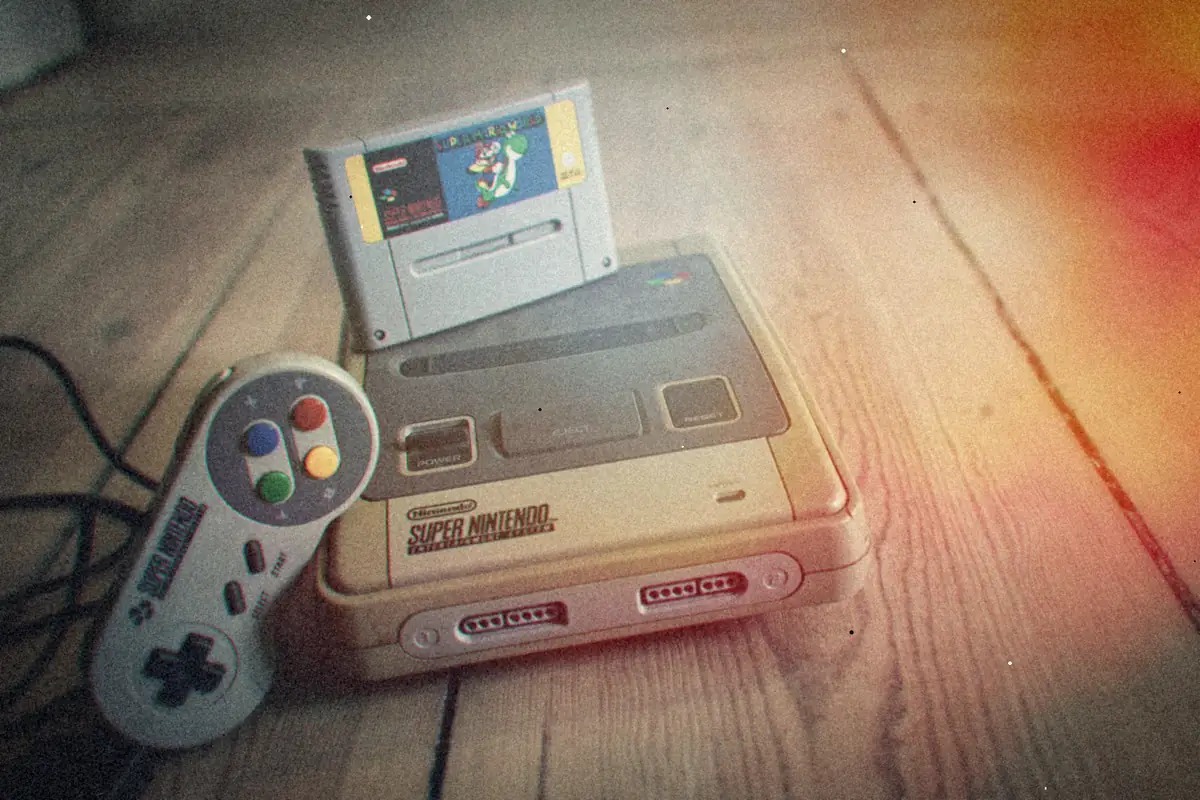
In North America, the Super Nintendo came in two shapes. There's the big, boxy original with the purple buttons from 1991, and a small, rounded redesign, the SNS-101, that Nintendo released in 1997, when the Nintendo 64 was already out. People call it the SNES Mini, the Jr. or the Model 2, which is confusing now that the SNES Classic also gets called the Mini.
They play the same games. What differs is the picture, the ports and the plastic.
Side by side
| Original SNES (1991) | SNS-101 (1997) | |
|---|---|---|
| Look | Big, boxy, two-tone gray with purple | Small, rounded, all light gray |
| Cartridges | Eject button | No eject button; pull the cart straight out |
| Power | Slide switch | Push button |
| Video out | RF, composite, S-Video and RGB through the AV port | RF and composite only |
| Picture inside | Early boards a bit soft; 1CHIP boards sharp | 1CHIP-based, sharp once modded |
| Expansion port | Yes, on the bottom (barely used) | No |
| Power adapter | SNS-002, 10V | The same SNS-002 |
| Yellowing | Prone to it | Much less |
In Japan, the equivalent small redesign was the Super Famicom Jr.
The original: the one with the ports
The original's big advantage is the AV port. It outputs composite, S-VideoA video connection that keeps brightness and color on separate wires. A clear step up from composite, one step below RGB.More: RGB and Retro Consoles: Which Ones Need a Mod and Which Just Need a Cable and RGB, so with the right cable you can get a clean picture into a CRTCathode-ray tube. The deep, heavy glass TV everybody had before flat screens.More: CRT 90s TV: Channel Surfing Like It's 1996, on a Raspberry Pi or a upscalerA box that takes an old console's low-resolution signal and turns it into something a modern TV displays cleanly, ideally without adding lag.More: RGB and Retro Consoles: Which Ones Need a Mod and Which Just Need a Cable without opening anything.
Picture quality varies by what's inside:
- Early two-chip boards have a slightly soft picture, even over RGB.
- The later 1CHIP boards combine those chips into one and are considerably sharper. They're the ones people hunt for. You can't tell from the outside, only from the board revision printed inside, so ask sellers to check if it matters to you.
Heads up
The 1CHIP design has a small number of game compatibility quirks. They're rare and well documented, but look up your favorites if you're buying one to play a particular game.
The original's downside is age. The gray plastic yellows badly on a lot of units, and yellowed shells get brittle too.
The SNS-101: small and sharp, if you open it
The 1997 model was a cost-reduced, late-life budget console, and it shows in the connections: composite and RF only. S-Video and RGB aren't available from the AV port without a mod.
Inside, though, it uses the same 1CHIP design as the best late originals. With an RGB modA modification that gets a console's clean red, green and blue video signal out to the TV, instead of the blurry composite picture most of us grew up with.More: RGB and Retro Consoles: Which Ones Need a Mod and Which Just Need a Cable it's just as crisp. Without one, you're stuck with composite, and composite is exactly where old console pictures look their worst.
Other things it dropped:
- The eject button. Carts pull straight out, which is fine.
- The expansion port. Almost nothing used it, so few people miss it.
- Bulk. It's much smaller and lighter, which is its real selling point.
It yellows far less than the original, which is nice if you care how it looks on the shelf.
Note
Both models use the same SNS-002 power adapter, 10 volts. Check the plug and voltage on any third-party brick before you trust it with a 30-year-old console.
Which one I'd get
Get an original if:
- You want RGB or S-Video without soldering. This is the big one.
- You want the classic look, purple buttons and all.
- You care about the best possible picture. Look for a 1CHIP original.
Get an SNS-101 if:
- Space is tight and you only need composite.
- You're comfortable doing an RGB mod, or paying for one. Then it's as good as the best originals.
- You'd rather it didn't turn the color of a smoker's ceiling.
For the whole RGB picture across consoles, including what a mod to the SNS-101 involves, see RGB modding retro consoles. Sega had the same kind of split across three models, and I compared those in the Genesis Model 1, 2 and 3 rundown. The rest of Nintendo's home consoles are in NES to Wii U.